For decades, managing public sector finances, state expenditures, and bureaucratic payroll records in Pakistan relied heavily on fragmented, slow, and error-prone manual bookkeeping systems. Paper ledgers, delayed audits, and physical queues for routine tasks like retrieving a monthly salary slip created unnecessary administrative bottlenecks. To permanently alter this landscape and root out inefficiencies, the government introduced a transformative initiative known as the Project to Improve Financial Reporting and Auditing (PIFRA).
Representing a monumental step toward achieving maximum financial accountability and transparency, this digital architecture completely digitizes government expenditures, budgeting workflows, and audit mechanisms. Backed by key institutions such as the Pakistan Audit Department, the Controller General of Accounts (CGA), the Ministry of Finance, and respective Provincial Finance Departments, PIFRA serves as the core backbone of the nation’s public financial management.
This comprehensive guide explores the structural foundation, primary aims, key operating components, core objectives, and broader significance of PIFRA in modernizing Pakistan’s public sector governance.
The overarching concept behind PIFRA goes beyond simple software deployment; it represents a cultural and structural shift toward modern governance. Funded with a substantial budgetary allocation to the tune of 5,553 million, the project has evolved into a viable, highly effective instrument designed to enforce rigorous financial audits across all government tiers.
The initiative is built upon close collaboration among multiple premier state entities:
- The Pakistan Audit Department: Ensures that post-expenditure tracking adheres strictly to national interest and statutory compliance.
- The Controller General of Accounts (CGA): Oversees accounting records, transaction processing, and public treasury workflows.
- The Ministry of Finance & Provincial Finance Departments: Coordinate budgetary allocations, fund releases, and macro-fiscal frameworks.
Through this unified institutional backing, the official PIFRA web portal maintains an exhaustive online record of budgetary allocations, departmental expenditures, and payroll profiles, allowing government employees to manage their financial documents with unprecedented ease.
To achieve its grand vision of structural reform, PIFRA is anchored by four foundational components that dictate its operational capability:
- Federal Accounting and Budgeting System (FABS): Acting as the technological engine of the entire initiative, FABS centralizes accounting, budgeting, and reporting into a unified digital framework. It replaces legacy systems with an integrated enterprise resource planning approach, enabling real-time recording of financial transactions.
- Enhancing the Capacity Building of the Auditor General’s Office: Modernizing financial reporting requires upgrading human capital and institutional infrastructure. This component focuses on training audit personnel, integrating modern data analytics, and aligning national auditing practices with global standards.
- Promoting Effective Project Management: Ensuring the long-term sustainability of a nationwide reform requires structured oversight, rigorous monitoring milestones, resource optimization, and strategic deployment schedules across federal, provincial, and district levels.
- Enhancing the Capacity Building of the Controller General of Accounts’ Office: By equipping the CGA’s office with advanced technical tools, streamlined workflows, and skilled personnel, the system ensures that accounting and pre-audit functions are executed without administrative delays.
PIFRA was conceptualized to eliminate obstacles hindering national progress and prosperity. By addressing historic gaps in public finance, the project aims to foster a fully integrated financial management system (IFMS) defined by professionalism and strict accountability.
The primary guiding concepts and operational objectives include:
- Upgrading Audit Mechanisms: Elevating national auditing standards to match internationally recognized Standard Operating Procedures (SOPs), ensuring that public funds are scrutinized under rigorous global best practices.
- Maximizing Transparency: Publishing financial disclosures online to invite public scrutiny, minimize corruption risks, and guarantee open governance.
- Preventing Financial Mismanagement: Closing administrative loopholes to drastically reduce fiscal leakages, unauthorized expenditures, and state revenue losses.
- Building Public Trust: Establishing a reliable, transparent financial ecosystem that reassures citizens and international partners regarding the integrity of Pakistan’s public spending.
Accessing the Portal
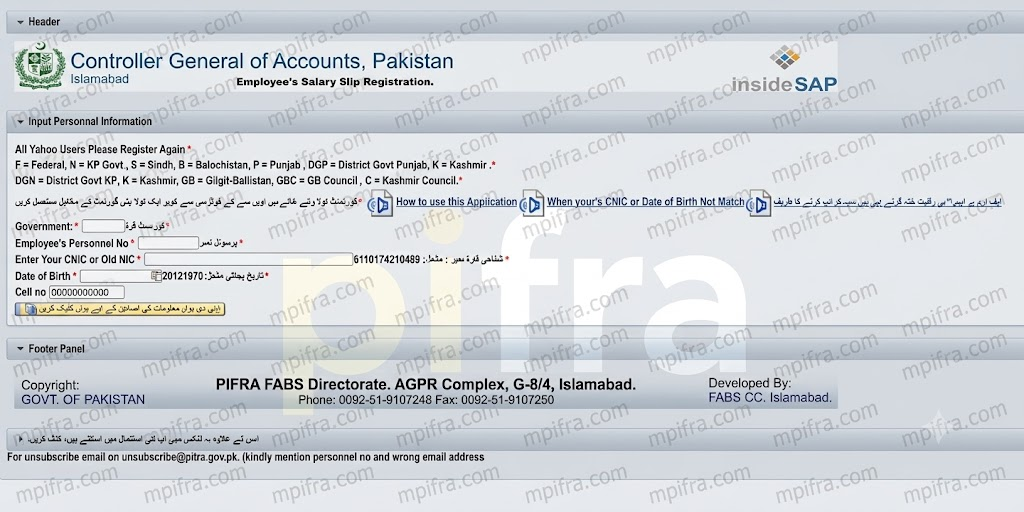
This image shows the initial login screen where the user enters their employee details.

A clean screenshot of the PIFRA web portal on a laptop. The screen displays the “Government Employee Salary Slip Registration” form with fields for Government Code, Employee ID, CNIC, and Date of Birth, ready for input.
2: Verification Success
This image captures the screen after the system successfully verifies the user’s credentials.
A close-up of the laptop screen. The form fields are now populated, and the “Verify Your Information” button is greyed out. A bright green banner confirms “Verification Successful,” indicating the user’s data matches the government database.

3: Email Registration
This image shows the subsequent step where the verified user registers their email address.
A screenshot of the laptop screen focused on the “Email Registration” stage. The user is presented with two empty fields to enter and confirm their email address, followed by a prominent “Register Email” button.

Final Confirmation
This image displays the final screen confirming that the email has been successfully registered.
A close-up of the laptop screen showing a large, bold “Success!” message within a green box. It confirms that the email has been successfully registered and the user will now receive monthly salary slips.

Frequently Asked Questions (FAQs)
The main objectives of PIFRA include modernizing public sector accounting, automating budgeting and auditing procedures, enhancing financial transparency through online data disclosures, eliminating fiscal mismanagement, and aligning national auditing standards with international best practices.
A government code in the PIFRA framework is a unique alphabetical prefix assigned to distinguish different federal, provincial, and district territories (such as ‘P’ for Punjab, ‘S’ for Sindh, ‘F’ for Federal, and ‘N’ for KPK) to correctly route payroll and expenditure data.
PIFRA employee information refers to the digital master profile of a public sector worker stored within the database. It links personal credentials—such as Employee ID, CNIC number, date of birth, and official government codes—with active email addresses to automate monthly salary and pension slip dispatches.
Conclusion
Ultimately, PIFRA stands out as one of the most impactful administrative reforms launched by the government to foster absolute financial accountability and robust auditing. By replacing outdated manual ledgers with a digitized, transparent ecosystem, the initiative safeguards public funds while simplifying day-to-day administrative tasks for government personnel. As the system continues to undergo strategic upgrades to cover broader operational domains, it moves closer to realizing a fully integrated, future-ready financial management framework for Pakistan.